
Voir cette page en français
CALENDRIER DU VIVANT
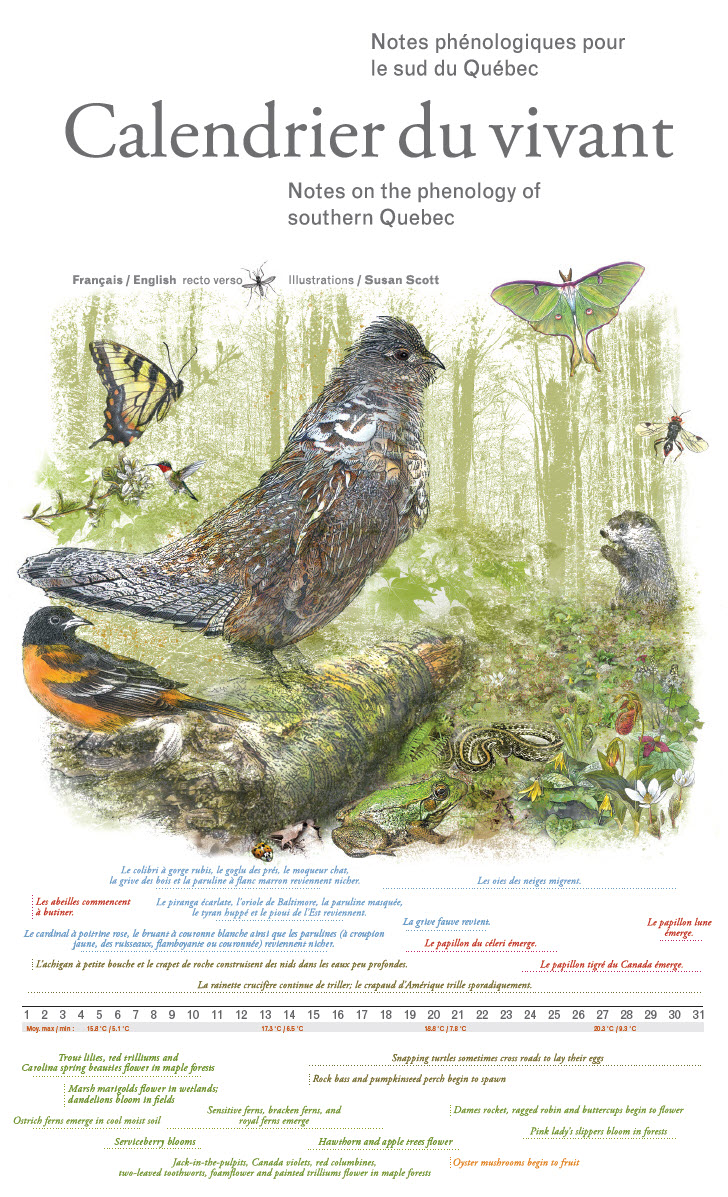
Notes on the phenology of southern Quebec
The Mount Pinnacle Land Trust is pleased to present the first edition of its Calendrier du vivant. The calendar tracks the seasonal appearance of flora and fauna in southern Quebec.
What it is
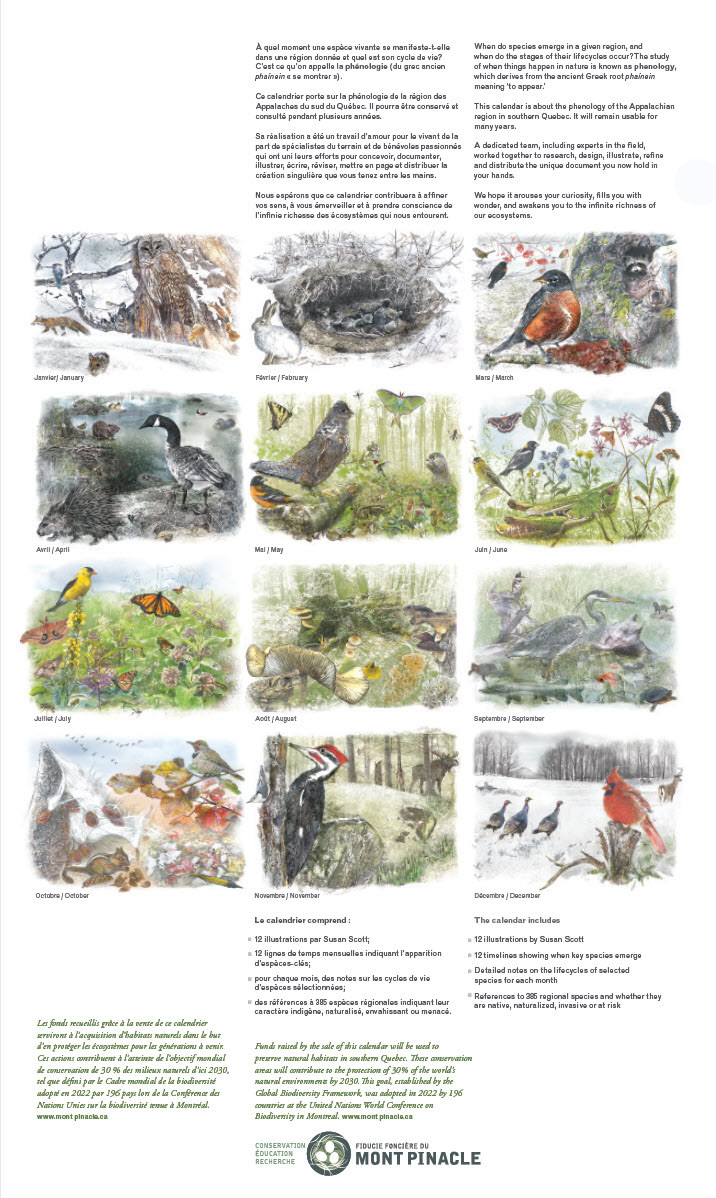
Phenology is the study of when natural events occur. This phenology calendar traces the seasonal rhythms of over 300 native plants, insects, birds, and mammals in southern Quebec, showing when migrating species return, when mating seasons begin, and when plants and fungi emerge. As a perpetual calendar, it can be displayed year after year until climate change makes an update necessary.
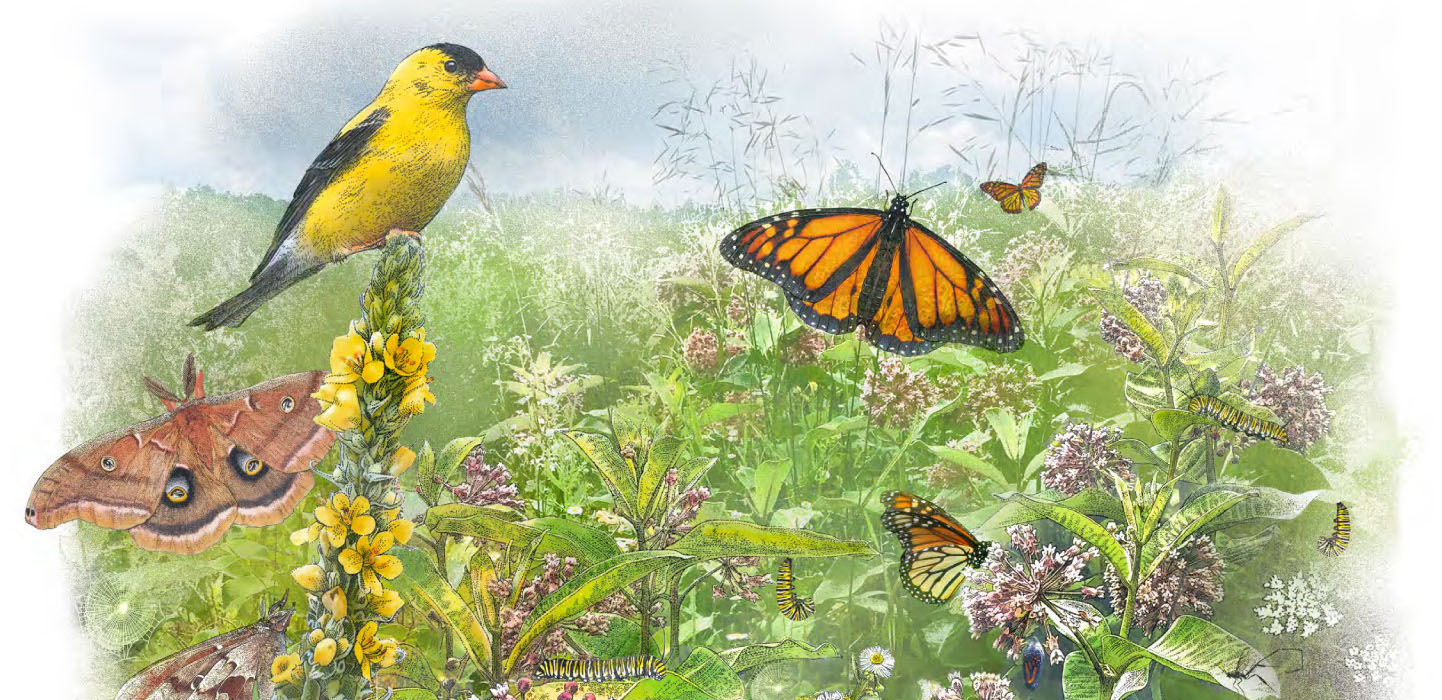
Created by 40 volunteers—including biologists and field experts—the calendar owes its visual appeal to Susan Scott’s extraordinary illustrations.
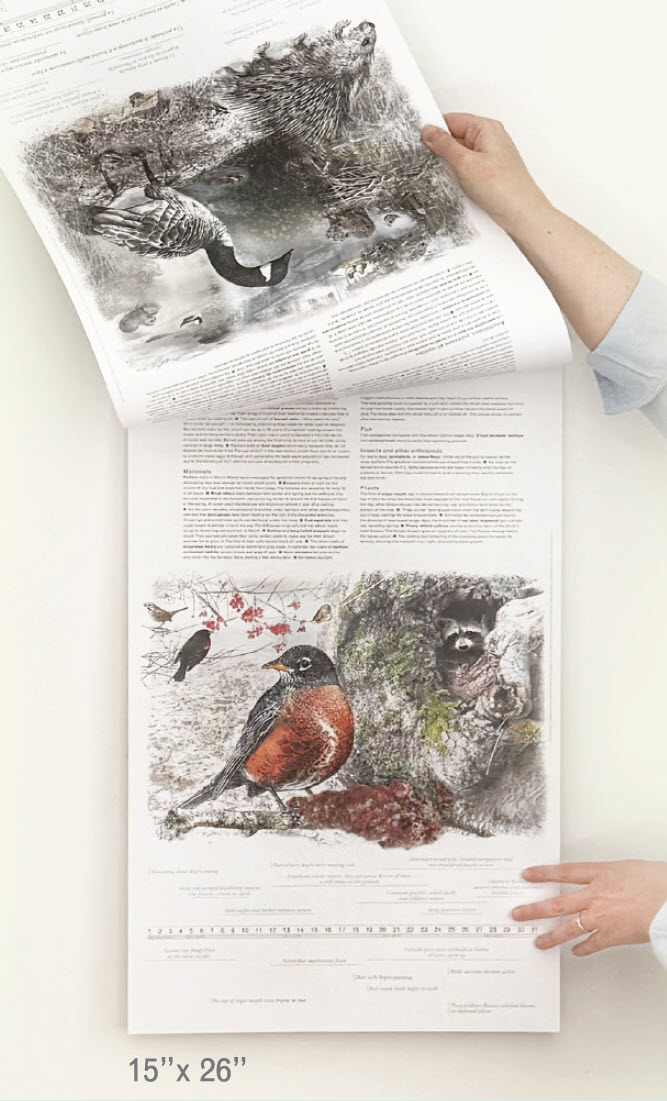
The calendar is printed in large format (15″ × 26″ or 38 cm × 66 cm) on cover stock and is available for $85 + GST.
What it includes
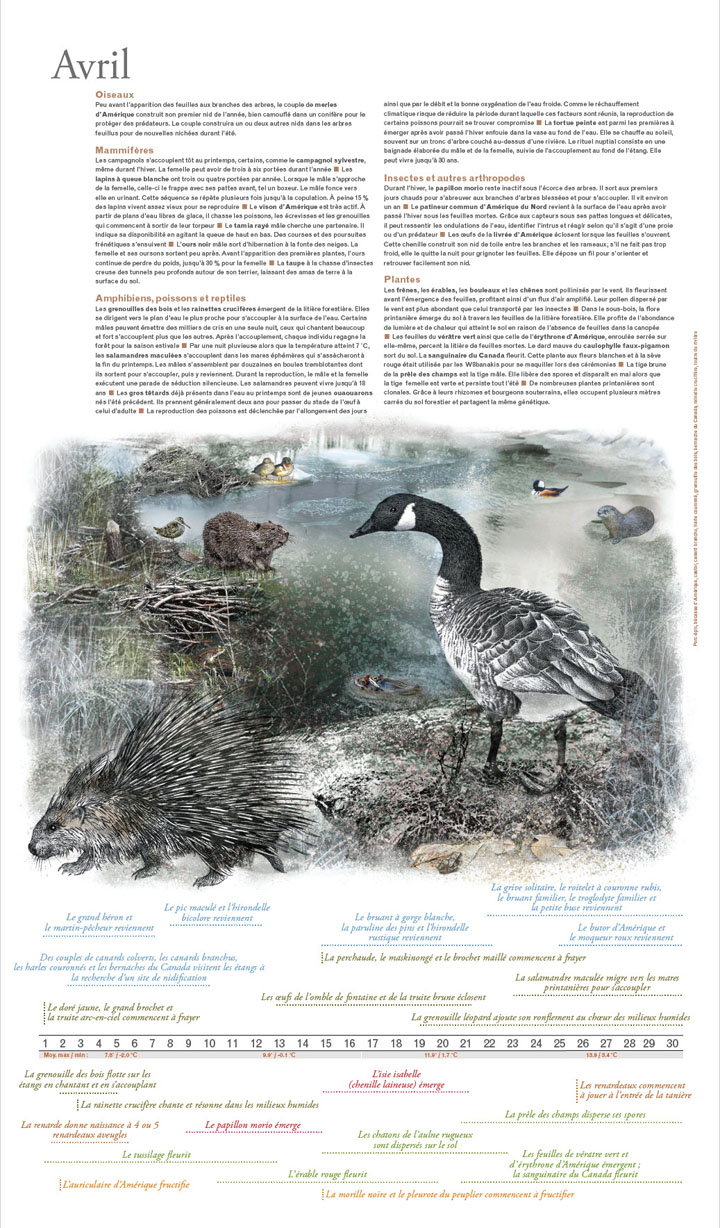
- 12 original illustrations by Susan Scott
- 12 timelines showing when key species emerge
- Detailed notes on the lifecycles of selected species for each month
- References to 385 regional species and whether they are native, naturalized, invasive or at risk
- French and English versions printed back-to-back
What calendar sales will support
This project was made possible thanks to funding received under the Programme de soutien à la mission des organismes environnementaux, managed by the ministère du Développement durable, de l’Environnement et de la Lutte contre les changements climatiques (MDDELCC).
Proceeds raised by the sale of the calendar will help preserve natural habitats in southern Quebec and fund educational programs that promote conservation awareness.

Taille du calendrier

Couverture

Quatrième de couverture
Where to buy it
| Municipality | Store | Address (click to locate) |
| Bromont | L’art de vivre | 831 Rue Shefford |
| Cowansville | Verveine & Cie | 101 Rue Albert |
| Frelighsburg | Dépanneur du village | 1, rue de l’Église |
| Frelighsburg | La petite cocagne | 33A Chemin de Dunham |
| Frelighsburg | Oneka Boutique | 23 Rue Principale |
| Knowlton | Brome Lake Books | 45 Chemin Lakeside |
| Granby | Centre d’interprétation de la nature du lac Boivin | 700 rue Drummond |
| Magog | Centre d’interprétation du Marais de la Rivière-aux-Cerises | 69 chemin Roy |
| Percé | Nath & Compagnie | 224 QC-132 |
| Stanbridge East | Café Blinn | 12 Rue River |
| Stanbridge East | Missisquoi Museum | 2 rue River |
| Sutton | Atelier Bouffe | 14 Rue Principale Sud |
| Sutton | L’Échappée belle | 8 Rue principale Sud |
| Westmount | Hogg Hardware | 4855 Rue Sherbrooke Ouest |
Works Consulted
The following is a partial list of the sources we consulted to research the calendar.
Association Canadienne des médecins vétérinaires. (s.d.). Tique Toc. www.tiquetoccanada.com
Barron, G. (1999). Mushrooms of Ontario and eastern Canada. Lone Pine Publishing.
Bessette, A., Roody, W. C., & Bessette, A. (2017). Boletes of eastern North America (2nd ed.). Syracuse University Press.
Box, O. (2021). Are peepers starting to peep earlier? JStore Daily. https://daily.jstor.org/are-peepers-starting-to-peep-earlier/
Chettih, S. N., Girardeau, G., Gurnsey, K., Cocchi, A. A., & Yip, E. (2024). Barcoding of episodic memories in the hippocampus of a food-caching bird. Cell, 187(8), 1922–1935.e20. https://doi.org/10.1016/j.cell.2024.02.032
Comité sur la situation des espèces en péril au Canada (COSEPAC). (2025). Espèces sauvages candidates du COSEPAC. https://cosewic.ca/index.php/fr/rapports/especes-sauvages-candidates.html
Conservation de la nature Canada. (2024). Conservation de la nature Canada. www.natureconservancy.ca
Cornell Lab, Colorado State University, & The University of Massachusetts Amherst. (2023). BirdCast: Migration dashboard. https://dashboard.birdcast.info
Cornell University. (2024). Cornell lab: All about birds. www.allaboutbirds.org
Darbyshire, S. J. (2003). Inventaire des mauvaises herbes du Canada (M. Favreau, trad.). Agriculture et Agroalimentaire Canada.
Des Rivières, P. (2020). Le monde fascinant des myxomycètes sous la loupe de Suzanne Béland. Québec Science. https://www.quebecscience.qc.ca
Desroches, J. F., & Rodrigue, D. (2004). Amphibiens et reptiles du Québec et des Maritimes. Éditions Michel Quintin.
Dindo, M. L., Francati, S., Lanzoni, A., Di Vitantonio, C., Marchetti, E., Burgio, G., & Maini, S. (2016). Interactions between the multicolored Asian lady beetle Harmonia axyridis and the parasitoid Dinocampus coccinellae. Insects, 7(4), 67. https://doi.org/10.3390/insects7040067
Dorion, P. (2024). L’identification des champignons sauvages (2e éd.). Éditions MultiMondes.
Duell, M. E., Gray, M. T., Roe, A. D., MacQuarrie, C. J. K., & Sinclair, B. (2022). Plasticity drives extreme cold tolerance of emerald ash borer (Agrilus planipennis) during a polar vortex. Current Research in Insect Science, 2, 100037. https://doi.org/10.1016/j.cris.2022.100037
eBird. (2023). Observations eBird pour Brome-Missisquoi, Québec, 2013–2023 [Ensemble de données]. Cornell Lab of Ornithology. http://www.ebird.org
Edwards, H. (2009). Desmognathus fuscus, dusky salamander. Animal Diversity Web, University of Michigan Museum of Zoology. https://animaldiversity.org/accounts/Desmognathus_fuscus/
Espace pour la vie Montréal. (s.d.). Où et quand peut-on trouver des champignons? Carnet horticole et botanique : Champignons. https://espacepourlavie.ca/ou-et-quand-peut-trouver-des-champignons
Ewert, M. A., Lang, J. W., & Nelson, C. E. (2005). Geographic variation in the pattern of temperature-dependent sex determination in the American snapping turtle (Chelydra serpentina). Journal of Zoology, 265(1), 81–95. https://doi.org/10.1111/j.1469-7998.2004.00267.x
Fabian, S. T., Sondhi, Y., Allen, P. E., Theobald, J. C., & Lin, H.-T. (2024). Why flying insects gather at artificial light. Nature Communications, 15(1), 689. https://doi.org/10.1038/s41467-024-44785-3
Gouvernement du Canada. (2025). Normales climatiques canadiennes. https://climat.meteo.gc.ca/climate_normals/index_f.html
Gouvernement du Québec. (2024a). Espèces exotiques envahissantes (EEE). https://www.environnement.gouv.qc.ca/biodiversite/especes-exotiques-envahissantes/index.asp
Gouvernement du Québec. (2024b). Liste des espèces fauniques menacées ou vulnérables. https://www.quebec.ca/agriculture-environnement-et-ressources-naturelles/faune/gestion-faune-habitats-fauniques/especes-fauniques-menacees-vulnerables/liste
Gouvernement du Québec. (2024c). Liste des espèces floristiques désignées menacées ou vulnérables ou susceptibles de l’être. https://www.environnement.gouv.qc.ca/biodiversite/especes-designees-susceptibles/index.htm
Gouvernement du Québec. (2025). Liste des espèces floristiques et fauniques susceptibles d’être désignées menacées ou vulnérables. Dans Légis Québec. https://www.legisquebec.gouv.qc.ca/fr/document/rc/e-12.01,%20r.%205
Holland, M. (2019). Naturally curious: A photographic field guide and month-by-month journey through the fields, woods and marshes of New England. Trafalgar Square Books.
iNaturalist. (2023). Observations de qualité recherche iNaturalist pour la région de Brome-Missisquoi, 2015–2023 [Ensemble de données]. iNaturalist.org. https://www.inaturalist.org
Kimmerer, R. W. (2003). Gathering moss: A natural and cultural history of mosses. Oregon State University Press.
Lajoie, G., & Vellend, M. (2015). Understanding context dependence in the contribution of intraspecific variation to community trait-environment matching. Ecology, 96(11), 2912–2922. https://doi.org/10.1890/14-1957.1
Lamoureux, G. (2002). Flore printanière : Guide d’identification. Fleurbec.
Lewis, M. (2022). What happens to invasive species in winter? Land Lines: The Nature Conservancy of Canada blog. www.natureconservancy.ca
Marie-Victorin, Frère, Rouleau, E., & Brouillet, L. (1995). Flore laurentienne (3e éd.). Gaëtan Morin éditeur.
McNeil, R. (2015). Champignons du Québec et de l’est du Canada. Éditions Michel Quintin.
Morley, E. L., & Robert, D. (2018). Electric fields elicit ballooning in spiders. Current Biology, 28(14), 2324–2330.e2. https://doi.org/10.1016/j.cub.2018.05.057
Morse, S. (2019). Wildlife and habitats: A collection of tracking and natural history essays with photography by Susan C. Morse. Keeping Track Inc.
Mycoboutique. (2024). Calendrier des récoltes gastronomiques. Mycoscope, 2, 1–4.
Nilsson, A. (2024). Black-capped chickadee: A different meaning to bird brain. Northwoods Wildlife Center. https://northwoodswildlife.org/black-capped-chickadee-a-different-meaning-to-bird-brain/
Nolett, M. D. (2008). Plantes du soleil levant Waban Aki : Recettes ancestrales de plantes médicinales. Conseil des Abénakis d’Odanak.
Perron, M. (2024). Flore du Québec : 131 espèces. www.floreduquebec.ca
Prescott, J., & Richard, P. (2013). Mammifères du Québec et de l’est du Canada (3e éd.). Michel Quintin.
Rezendes, P. (1992). Tracking and the art of seeing: How to read animal tracks and sign. Camden House Publishing.
Rivest, S., Lajoie, G., Watts, D. A., & Vellend, M. (2021). Earlier spring reduces potential for gene flow via reduced flowering synchrony across an elevational gradient. American Journal of Botany, 108(3), 538–545. https://doi.org/10.1002/ajb2.1634
Robert, M., Hachey, M.-H., Lepage, D., & Couturier, A. R. (dir.). (2019). Deuxième atlas des oiseaux nicheurs du Québec méridional. Regroupement Québec Oiseaux, Service canadien de la faune (Environnement et Changement climatique Canada) et Études d’Oiseaux Canada. https://www.atlas-oiseaux.qc.ca/telechargement_fr.jsp
Sabourin, A. (2018). L’aubépine du Canada (Crataegus canadensis Sargent), une espèce à part entière, endémique au Québec et différente de l’aubépine subsoyeuse (Crataegus submollis Sargent). Le Naturaliste canadien, 142(1), 6–15. https://doi.org/10.7202/1042013ar
Stephenson, S. L. (2023). Past and ongoing field-based studies of myxomycetes. Microorganisms, 11(9), 2283. https://doi.org/10.3390/microorganisms11092283
University of Michigan. (2020). Animal Diversity Web. www.animaldiversity.org
Weiler, N. (2015). Wasp virus turns ladybugs into zombie babysitters: Viral mind control is perfectly timed. Science. https://doi.org/10.1126/science.aaa7844
Welz, A. (2023). The end of Eden: Wild nature in the age of climate breakdown. Bloomsbury Publishing.
How to send us your feedback
We welcome your comments. Please use this this form to share your feedback with us. If applicable, kindly include links to your sources. The best way to incorporate your observations into future editions of the calendar is by uploading them to iNaturalist; bird observations should be submitted to eBird. The Mount Pinnacle Land Trust thanks all the citizen scientists in the region whose perceptive observations of the natural world are contributing to our research.